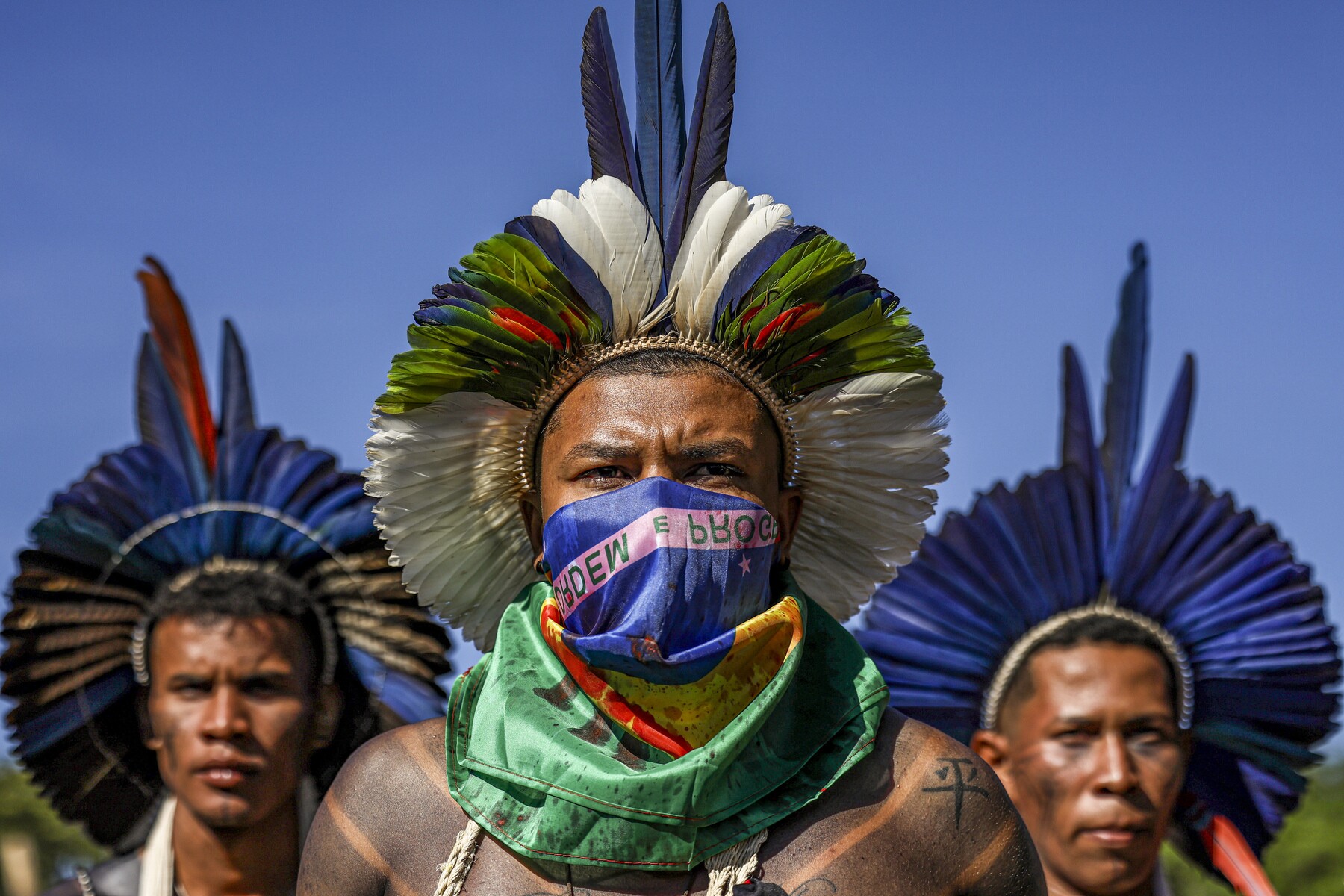
The impacts of the climate crisis are evident in fishing, subsistence agriculture, and people’s health, altering habits and ways of life in various regions of Brazil. This is what Indigenous youth of different ethnicities felt and expressed to Agência Pública during the country’s largest Indigenous collective action, the Free Land Camp (Acampamento Terra Livre -ATL), which takes place every April.
“We don’t fish now like we did eight, [or] six years ago. On Bananal Island (the world’s largest river island), there were lots of fires last year. It is an accumulation of various factors that are having an impact. In the case of my Karajá people, we never thought there wouldn’t be enough fish [one day]. We have to go to a specific lake now to fish, you know?” said 25-year-old Maluá Silva Kuady Karajá.
She emphasized that the exacerbation of global warming is not only something appearing in scientific data. “It is changing everyday life completely. It has changed the biome, the fauna, our way of life, our lives. And it brings other difficulties that go beyond the climate question,” said the young Indigenous woman.
One of the main priorities of this year’s event is to coordinate and guarantee Indigenous action at COP30, the UN’s climate conference, which will take place in Belém, Brazil, in November. The campaign “The Answer Is Us,” by the Organization of the Indigenous Peoples of Brazil (Apib), proposes that the demarcation of Indigenous lands be strategically included in the environmental goals of Amazonian countries.
“Discussing the environment without Indigenous people is already problematic, to say the least, especially here in our country, where the main [natural resources] reserves are within our territories,” explained Maluá. She stressed that their struggle for land does not aim to exploit it for economic purposes, but rather to discuss environmental challenges. “[This discussion] impacts many things that are part of the essence of our daily life.”
According to MapBiomas, a platform that helps to map deforestation and land use in Brazil, Indigenous lands represent 13 percent of the national territory, but account for only 1 percent of native vegetation loss between 1985 and 2023.
‘We can’t plant’

Yan Mongoyo, 21, lives in a transitional territory between the biomes of the Atlantic Forest and the Caatinga, in southeast Bahia state, northeastern Brazil, and explained that the prolonged drought has been hindering family farming in different ways. “It’s too dry, we can’t plant [crops]. It rained a little and we planted [crops], but they didn’t survive. So we are very concerned because our community is not supplied by piped water; it is supplied by a truck, one truck for three families. So there is no way to plant crops,” he said. “The people who are there on the ground are the ones who suffer the most, especially those working in family farming.”
Yan also criticizes the advance of agribusiness in Indigenous lands, especially in regions historically forgotten by the media and the state.
“No matter the region, [the ranchers] are invading [lands], destroying what they can destroy, and we are suffering. It is a challenge that all [Indigenous] people are facing,” he said. “I’ve been analyzing some newspapers, and I think, first, they stereotype us too much. Generally, they talk a lot about the Amazon and all that, and forget about the other biomes that are also very important. The Caatinga and the Cerrado regions are suffering a lot from these climate problems, [and] agrarian issues,” he observed.
The lack of debate about the Cerrado region is something that Leticia Awju Torino Krikati, 20, is trying to change. She is a city councillor for the Montes Altos municipality and the only Indigenous woman in the parliament in the state of Maranhão. She wants to show the importance of the biome for the country, “because it is where the sources of some of the largest rivers are found, and so an extremely important hydrographic base.”
Leticia says that she faces difficulties in including environmental questions in the development of municipal policy, as in Montes Altos, there is still no secretary for the environment. “This also affects discussions about climate change in Indigenous territories. We have the Department of Indigenous Affairs, but it also has to work in partnership with other departments,” the councillor said.
She recalled that the Krikati people, her ethnicity, are still awaiting the court’s decision for their lands to be actually handed over to them. Over 250 legal processes for demarcating Indigenous lands remain incomplete in Brazil, according to the Social-environmental Institute. The idea of the “marco temporal” (time marker), which proposes that Indigenous people should only have the right to claim for a lands if they were living on it at the time of the 1988 constitution, was made into law by the National Congress, despite it being deemed unconstitutional by the Supreme Court (Supremo Tribunal Federal, STF).
Illegal mining and food
“Today, non-Indigenous people use the term agro-ecology, but we know that agro-ecology is an appropriation of Indigenous knowledge, traditional knowledge,” observed Evelin Cristina Araújo Tupinambá, a 27-year-old geography professor in the city of Goiânia. In the classroom, she connects science and ancestry to explain climate change and the relationship between Indigenous territories and conservation.
Evelin also highlighted that Indigenous people’s concerns and priorities vary according to their territory and experiences. In her case, living for years in the capital of Goiás state, in central-western Brazil, one of her main struggles is the conservation of the Cerrado region. She compares this situation with that of her people, who live in the Amazon, where the challenges are different, such as the presence of logging, illegal resource extraction, and river pollution.
“They are different contexts, but they are linked, you know? I think that’s why our efforts stay connected to each other. Even though we are talking about different territories and biomes, our struggle is the same,” explained Evelin. “Here is an opportunity to make our complaints official. It’s a way to go directly to the plenary debates, to the Chamber [of Deputies]. Directly to the people who, institutionally speaking, make things happen.”
Maria Lilane, 24, from the Baniwa people of São Gabriel da Cachoeira, in the northern Brazilian state of Amazonas, sees the environment as a “second home,” and says that to destroy it is to destroy life itself.She criticizes food inequality in Brazil, which, even though it is one of the world’s largest food producers, does not ensure healthy food for everyone. “[Food] comes with an exorbitant price. It’s [also] toxic. As much as they try to make healthy food, we know that nowadays all industrialized food comes with a lot of pesticides. This has a great impact not only on the lives of Indigenous people, but for Brazilians in general.”



 PayPal