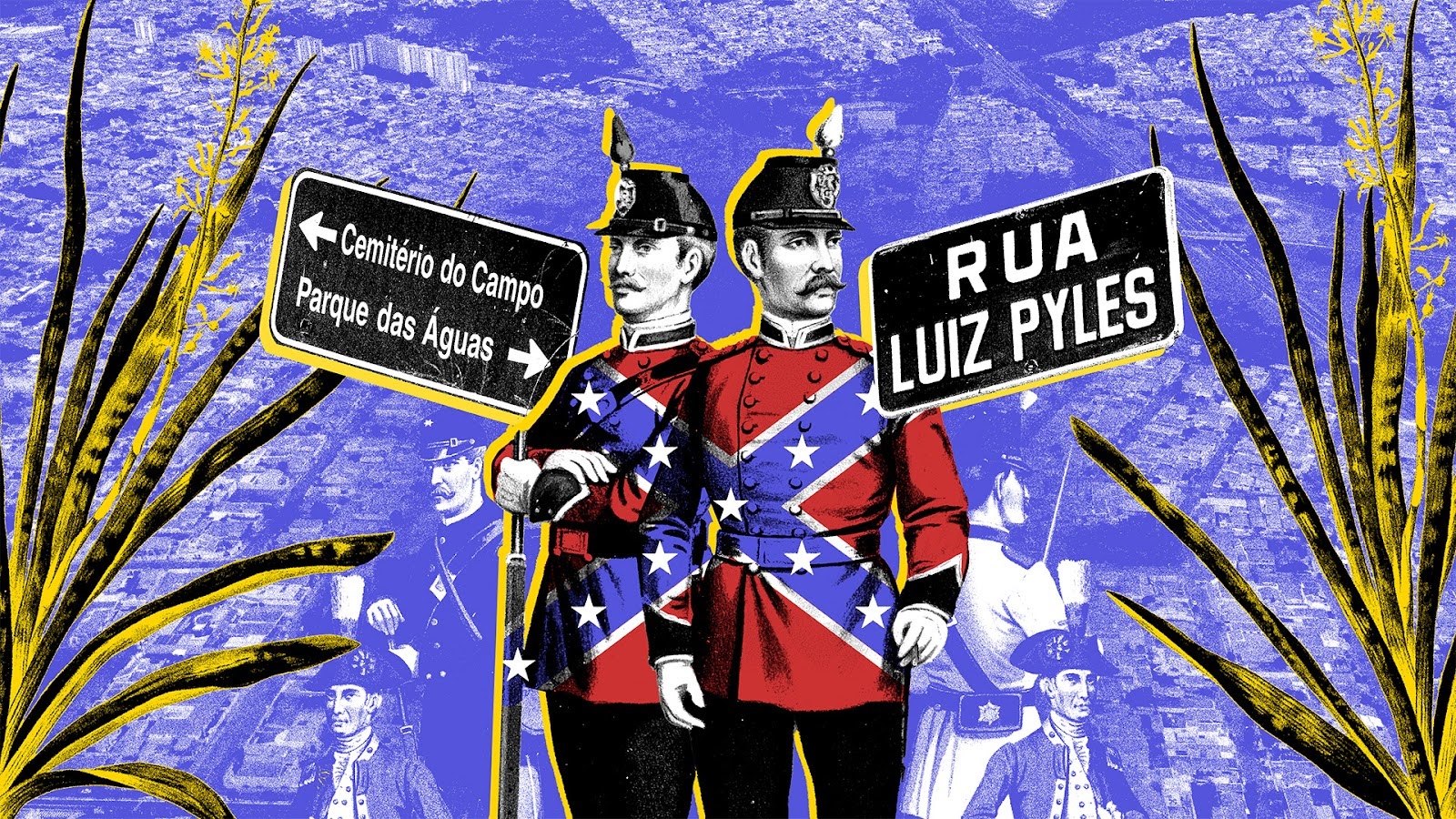
On a warm April afternoon in the Brazilian countryside, couples sway to country music — men in cowboy hats, women in hoop-skirted lace dresses twirling across the grass. Red flags emblazoned with a blue diagonal cross and white stars — the Confederate battle flag — hang over tables and stalls.
The scene might pass for a reenactment in Georgia or Alabama. But this is Santa Bárbara d’Oeste, a tiny industrial city of 183,000 in the state of São Paulo, where each year, until the pandemic, the “Festa dos Americanos” — literally, the Americans’ Party, or, more accurately, Confederate Party — celebrated the descendants of Southerners who fled the United States after their defeat in the Civil War (1861-1865).

About 2,000 Southerners came to Brazil in the post-US Civil War years, drawn by the Brazilian Empire’s incentives: free transport from Rio de Janeiro to the nearest port, exemption from military service, cheap land and freedom to run their own businesses, schools and Protestant churches. They brought with them agricultural expertise, cotton seeds — and, in some cases, enslaved people.
Historical records suggest that more than 200 enslaved men, women and children lived in the colony these immigrants built.
While the community celebrates its antebellum heritage — the food, music, dances and even varieties of watermelon brought from Georgia — a deeper history lies just beneath the surface: the continuation of a way of life dependent on slavery, transplanted to “a South further south.”

Between 1861 and 1865, the United States was torn apart by the Civil War, a clash between the industrializing, anti‑slavery North and the agrarian South, whose economy depended on enslaved labor. The North’s victory ended the Confederacy and freed more than 4 million people — but in Brazil, slavery would remain legal until 1888.
For some former Confederates, Brazil offered a refuge where the plantation system — and its racial hierarchy — could endure. Historian Maria Clara Sampaio notes that this was less about starting over than about transplanting a social order rooted in slavery.
The idea was not new. In the 1840s-50s, American expansionists had eyed the Amazon as ripe for colonization. Confederate agent Matthew Fontaine Maury even argued — with a veneer of science — that the Amazon and Mississippi River basins were naturally linked, justifying US influence in the region.
After the war, dozens of Confederate families settled in Brazil, founding colonies in places like Santa Bárbara d’Oeste, in São Paulo’s coffee belt. There, they could integrate into an economy still built on enslaved labor. Communities in more isolated regions — cut off from this slave‑based trade — soon withered.
The migrants’ pro‑slavery motives are often absent from local memory, replaced by pioneer myths and tales of agricultural success. Yet records tell another story. John Abraham Cole, a Mississippi slaveholder, smuggled a formerly enslaved woman, Silvy, and her daughters into Brazil in 1866 despite imperial bans. He went on to own 17 enslaved people in Santa Bárbara, where he lived alongside the first Confederate settler, Col. William Hutchinson Norris.

Santa Bárbara d’Oeste sits 130 kilometers (80 miles) from São Paulo, its streets bearing unfamiliar names: Pyles, Crisp, MacKnight, Jones — surnames of American settlers.
Archival deeds, studied by researcher Leticia Aguiar at the State University of Campinas, show that Confederate immigrants bought large tracts of farmland — and enslaved people to work them. The 1872 Imperial Census lists 2,589 inhabitants, of whom 213 were enslaved. Americans formed the largest foreign-born group.
The first recorded American land purchase was by Robert Meriwether in 1866, who also bought three enslaved people — two for farm labor, one for domestic work. Between 1866 and 1900, Aguiar found 26 transactions involving enslaved people alongside hundreds of property deals. Prominent settlers, such as Colonel Asa Thompson Oliver, owned enslaved laborers for their sugarcane, coffee and cotton plantations.
Some freed enslaved people were under restrictive conditions, requiring years of unpaid labor before manumission. Others, such as John Abraham Cole — who had owned 24 enslaved people in Mississippi — brought formerly enslaved black women into Brazil in defiance of imperial law, later acquiring more enslaved workers locally.

Today, Santa Bárbara’s official Immigration Museum offers rooms dedicated to Confederate migration, but only a single mention of slavery — referring to the city’s Portuguese founder in 1817.
The president of the Fraternity of American Descendants, Rogério Seawright, downplays this past, citing schools, hospitals and crops introduced by the immigrants. “That slaveholding legacy wasn’t here,” he insists, despite documented evidence to the contrary.
Since 2022, Confederate symbols — including the flag, now widely associated with white supremacy and the Ku Klux Klan — have been banned in public events. The ban followed years of pressure from black activists, particularly after Charlottesville’s deadly 2017 rally over the removal of a Robert E. Lee statue reignited global debates over Confederate symbols.
Seawright attributed the Confederate Party’s hiatus to budget constraints. His group, he said, is organizing smaller fundraising events in hopes of reviving the party.

Some descendants defend the flag as a harmless emblem of heritage. Others, such as architect Jeff Keese, reject it as “historically incorrect and shameful.” The dispute has split the fraternity, especially after its leadership took to social media to promote a 2022 visit by far-right lawmaker Eduardo Bolsonaro, former President Jair Bolsonaro’s third-eldest son.
Local politics remain sharply polarized. In 2021, a far-right lawmaker proposed designating the festival as cultural heritage — during Brazil’s Black Consciousness Month — prompting backlash. It took two years for the city council to pass a law banning racist symbols, despite fierce opposition from conservative members.
For Silvia Motta, a black community leader in nearby Americana, the problem goes beyond flags. She says the city “salutes an ethnicity that came from outside and enslaved people, while erasing the black history that built it.”
One example: Dionysio de Campos, kidnapped from Africa at age five, enslaved on local farms, and left landless after abolition. Today, his name survives in a cultural center that preserves Afro-Brazilian memory. But much of Santa Bárbara’s official narrative still centers on its Confederate past, not on the black lives exploited to sustain it.
The Confederates who came to Brazil sought more than farmland — they sought to preserve the racial and social order overturned in the US. Brazil, which would not abolish slavery until 1888, offered a final refuge for the slaveholding ideal.
Here, in Santa Bárbara, that legacy is still visible — in the street names, in the cemetery where American settlers lie beneath the Stars and Stripes, and, until recently, in a festival where hoop skirts and cowboy boots danced under the shadow of the Confederate flag.






 PayPal