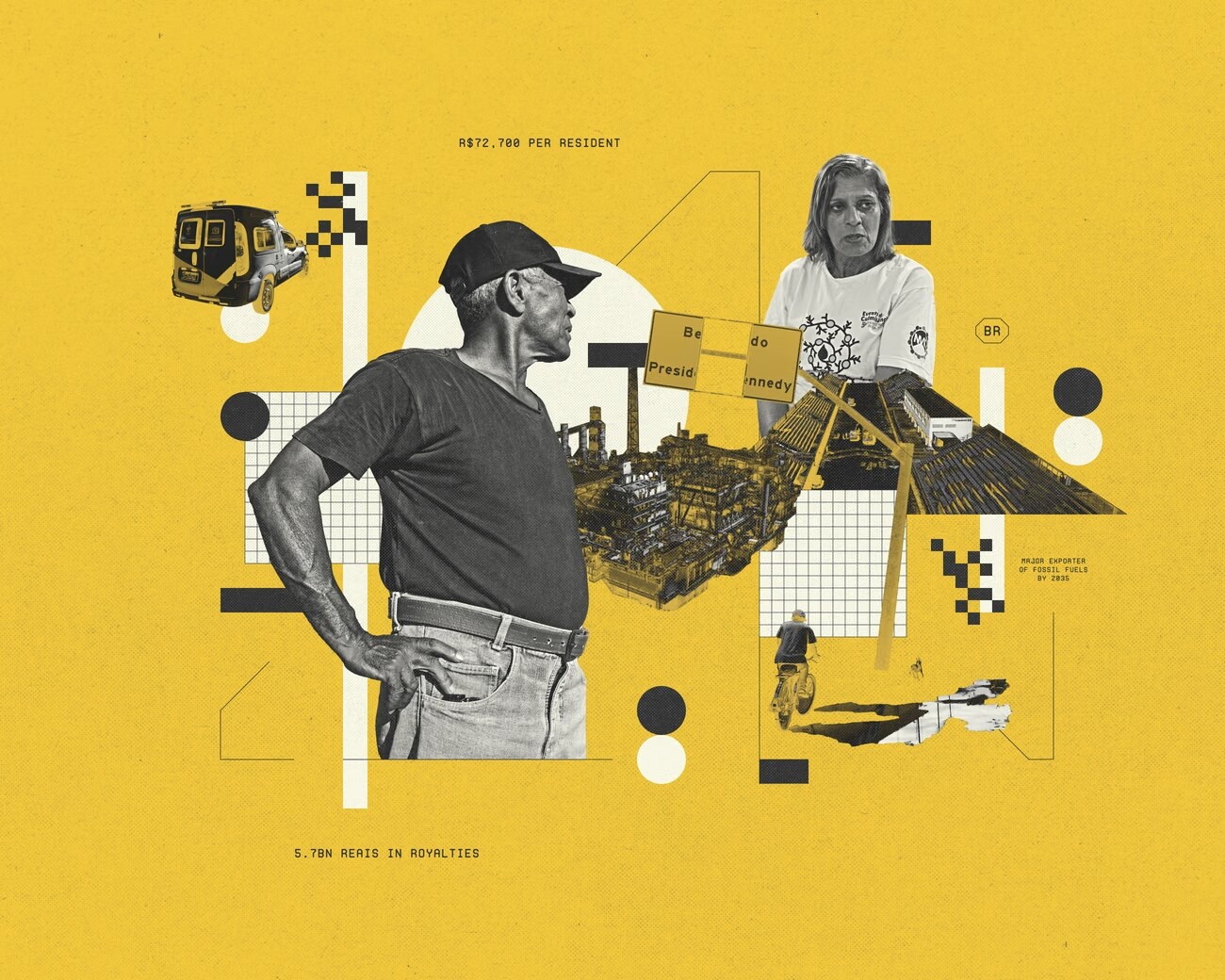
Though 60 miles (100km) apart, the Brazilian municipalities of Presidente Kennedy in Espírito Santo state and Campos dos Goytacazes in Rio de Janeiro state have one big thing in common: oil. Since late in the last century, their public funds have been bolstered by billions in royalties from oil finds in the offshore Campos Basin.
Yet despite having significantly more resources than other towns and cities in Brazil, both still face problems such as poor sanitation and healthcare, inadequate social housing and state education as well as corruption scandals.
The Brazilian government’s resolve to continue to explore for oil – in June, it announced it would auction a series of oil and gas exploration blocks, including 19 of 47 areas near the mouth of the Amazon River – echoes a decades-old Brazilian promise that oil exploration would benefit its people, despite evidence that it has not always resulted in gains for much of the population.

Analysis based on Candido Mendes University (Ucam)’s InfoRoyalties, a database of Brazilian oil revenues, reveals that most of the 15 municipalities with the highest oil revenues per capita between 1999 and 2024 have mediocre social and economic indicators, often ranking among the worst in their regions.
Adjusted for inflation, these municipalities collectively received nearly 150bn reais (£20bn) over the five years, or about R$95,000 for each resident.

One resident of Presidente Kennedy says: ‘Many say our people could be among the wealthiest, and I agree, given the royalties it receives.’
In 2023, six of these 15 municipalities are ranked lowest in their states based on the Brazilian federal government’s Basic Education Development Index for early primary education, while only four are top performers in later years.
More than half of the municipalities have rates of preventable deaths and infant mortality (ie of children aged less than one year) that are only average or worse for their states.
Our people could be among the wealthiest … the city should be a showpiece but instead it remains a city of misery
Félix de Jesus, farmer
Lia Hasenclever, a researcher at Ucam, says the oil revenues have had little positive impact on key socioeconomic development indicators. “Municipalities which do not receive royalties perform better in health and education than those that do,” she says. “Oil has an economic impact but no social impact.”
The small town of Presidente Kennedy holds the record for Brazil’s highest oil revenue per person. Between 1999 and 2024, the municipality received 5.7bn reais in royalties – or nearly R$390,000 for each of its 14,600 or so residents.

The oil boom provided “luxuries” that are rare in other municipalities of similar size and many public facilities were upgraded.
But everyday problems persist. Despite investments in health facilities, including the local hospital, residents are frustrated by the lack of provision for more complex medical care and complain about medicine shortages at health centres.
“If you need an MRI, ultrasound or to see a specialist, you have to go to other municipalities,” says one Presidente Kennedy resident who preferred not to be named. Pregnant women are sometimes forced to travel up to an hour to reach a birth centre or maternity ward, they add.
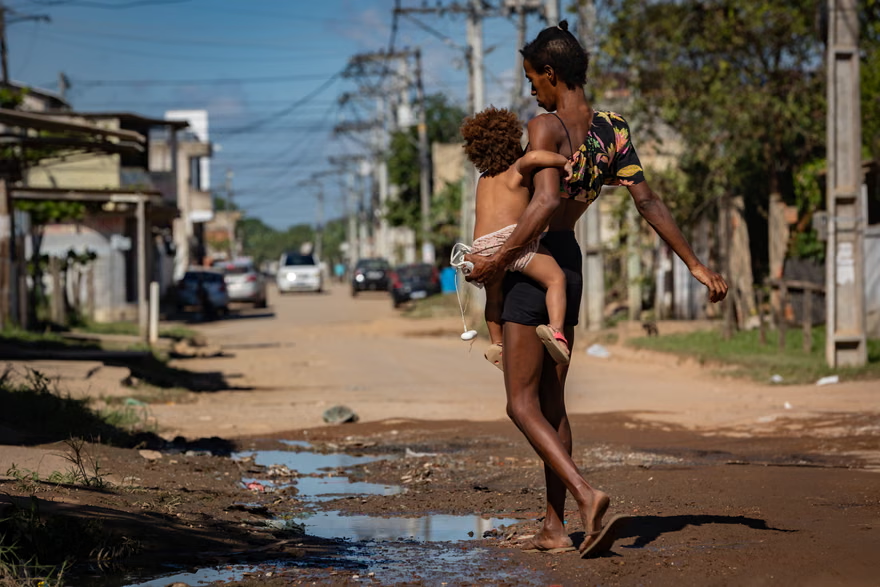
In the Marobá Beach area of Presidente Kennedy, basic sanitation is lacking and residents rely on bottled water. “The water here was very poor, sometimes tasting like iron. Now it’s better, but still not drinkable,” says Renata Oliveira, secretary of the town’s Z14 fishing company.

Félix de Jesus, a farmer, says he cannot see where the oil money goes. “Many say our people could be among the wealthiest, and I agree.
“Given the royalties it receives, the city should be a showpiece, but instead, it remains a city of misery,” he says. “Where is this money going?”
In Campos dos Goytacazes, a city of about 500,000 people, oil revenues totalled more than 37bn reais from 1999 to 2024, averaging R$72,700 per resident.
But, says Ucam professor Rodrigo Lira, “this budget increase has not resulted in social justice or reduced inequalities. No research demonstrates any progress in this area.”

As in Marobá, residents along Campos de Goytacazes’ only beach, Farol de São Thomé, lack basic sanitation and must install septic tanks themselves. Urban cleaning and rubbish collection services are poor, and residents use insect repellant constantly to deter the mosquitoes that breed nearby.
Local people also complain about the education provision. In Novo Jóquei, José Ricardo, a school caretaker who also offers low-cost tutoring for the area’s children through his charity, Anjos Solidários do Bem (Solidarity Angels of Good) – says there are teenagers moving from fifth to sixth grade, aged 11, without any solid educational foundation.
“We could be in a much better situation now if the politicians had invested in industry and in the city’s future,” he says.
Brazilian politicians have long championed the idea that oil wealth is key to the development of Brazil and its municipalities, ever since the first oilfields were explored.

Brazil’s goal is to become a leading global oil producer and a major exporter of fossil fuels by 2035. The National Petroleum Agency’s (ANP) expansion of offshore oil exploration, announced in June, was a proposal made by Luiz Inácio Lula da Silva’s leftwing government. it has already borne fruit: earlier this week BP announced that it has made its largest global oil and gas discovery in 25 years in the country’s Santos basin.
Lula, and other Brazilian policymakers such as the mines and energy minister, Alexandre Silveira, argue that oil extraction from the Equatorial Margin reserves, located 109 miles (175km) off the coast, which includes the Amazon River mouth, could boost development in the northern state of Amapá, which ranks 25th of Brazil’s 27 states in the country’s Human Development Index (HDI).

But Sergio Gobetti, from the Brazilian government’s Institute of Applied Economic Research (IPEA), argues that claiming oil money will solve Amapá’s socioeconomic problems is a predictable yet flawed argument.
“From Brazil’s and global experience,” he says, “there is no assurance that increased oil revenues will lead to true development.”




 PayPal