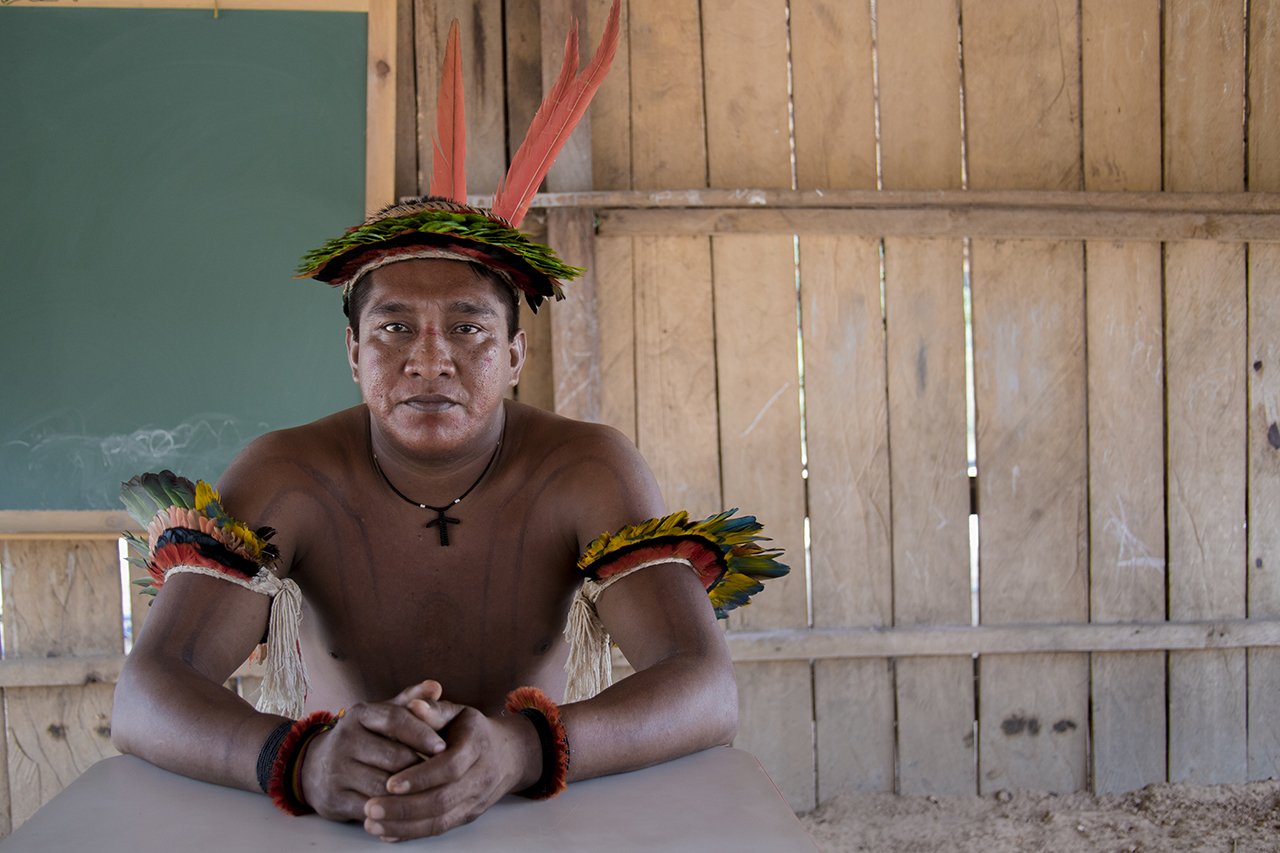
It was a letter of unity and solidarity. “Our forest, our rivers, our land are sacred to us,” wrote the Ka’apor tribe, from Maranhão in north-eastern Brazil, to the Munduruku, who live hundreds of miles away on the Tapajós river deep in the Amazon rainforest.

Both tribes are under threat from organised criminals who illegally grab land, log trees or prospect for gold. Now, tired of waiting for official protection that often fails to arrive, they are taking law enforcement into their own hands.
In three years, the Ka’apor have seized and torched 105 trucks carrying stolen timber, and closed down 14 illegal roads running through their lands, the tribe says. The Munduruku have delineated their own land in an effort to face down the lawless miners and land grabbers.
Their foes often have ties to politicians and police, which – combined with the absence of federal oversight – has compelled the tribes to strengthen and organise themselves in the face of an unequal struggle, one in which the state often seems an enemy or ally of the aggressors.
The Ka’apor live in the Alto Turiaçu indigenous territory. Since 1982, it has been granted a demarcated constitutional status that protects it for the tribe. But still the heavily forested area in the north of Maranhão has been invaded by illegal loggers, pillaging hardwood.
“A lot of this wood goes to Europe, to China, to other places,” says Gilderlan Silva, a representative of the Indian Missionary Council in Maranhão. “You have an economic power that goes right from the gas station owner, who finances the fuel of the logging truck, to the guy who owns the sawmill, right up to the financing of politicians.
“It is a market that drives a lot of money.”
In 2013, the Ka’apor created a management council based on the tribe’s historic principles. It was a break from their previous system of tribal chiefs, a tradition they say was imposed by Brazil’s National Indian Foundation (Funai).
The Ka’apor drafted an agreement to protect themselves, banning alcoholic drinks and drugs, which had arrived in the 17 villages in the hands of loggers.
Having recovered the illegal roads and deforested areas from invaders, the Ka’apor established seven villages as protected areas, to repel the intruders.
“We protected these areas because we did not want to see the end of our forest,” says Sarapó Ka’apor, one of the founders of the Ywyãhurenda village, a protected area that was previously an entry and exit point for logging trucks. “We got together with the council. We all gathered and took out the loggers. No one waited for Funai, we did it all ourselves.”
Such boldness has been the target of retaliation. Three members of the tribe have been murdered since 2010, in killings the tribe suspects were committed by their enemies. The crimes have not been solved. The tribe have also faced several invasions of their land, most recently in January, when 30 armed men threatened to burn down the houses in one village.
But last July, Michel Temer, the Brazilian president, obtained congressional approval to amend the constitution, legalising more than 2,000 irregular private properties on public lands in a move that was seen as sympathetic to the interests of land grabbers such as those in Maranhão.
The Ka’apor, meanwhile, say they have the legal right to decision-making powers over government policies that affect them. “According [to] the international conventions that Brazil has signed, indigenous communities should be the authors of the relevant public policy,” said Luís Antônio Pedrosa, a lawyer with the Society of Human Rights in Maranhão.

The Munduruku, likewise, studied strategies to strengthen the protection of their territory and keep the forest intact. For this, they meet other tribes, such as the Ka’apor, 10 times a year. In 2015, they demarcated their own territory in an attempt to keep out illegal miners and loggers. The tribe even has a problem with poachers stealing palmito, the vegetable of the palm tree.
Now, tribe members patrol the edge of their territory, looking for signs of invaders. “The people who are closest to the edge [of the territory] report back on if there has been an invasion,” said Juarez Saw Munduruku, chief of the Sawré Muybu village.



 PayPal