This article is a partnership with Mother Jones
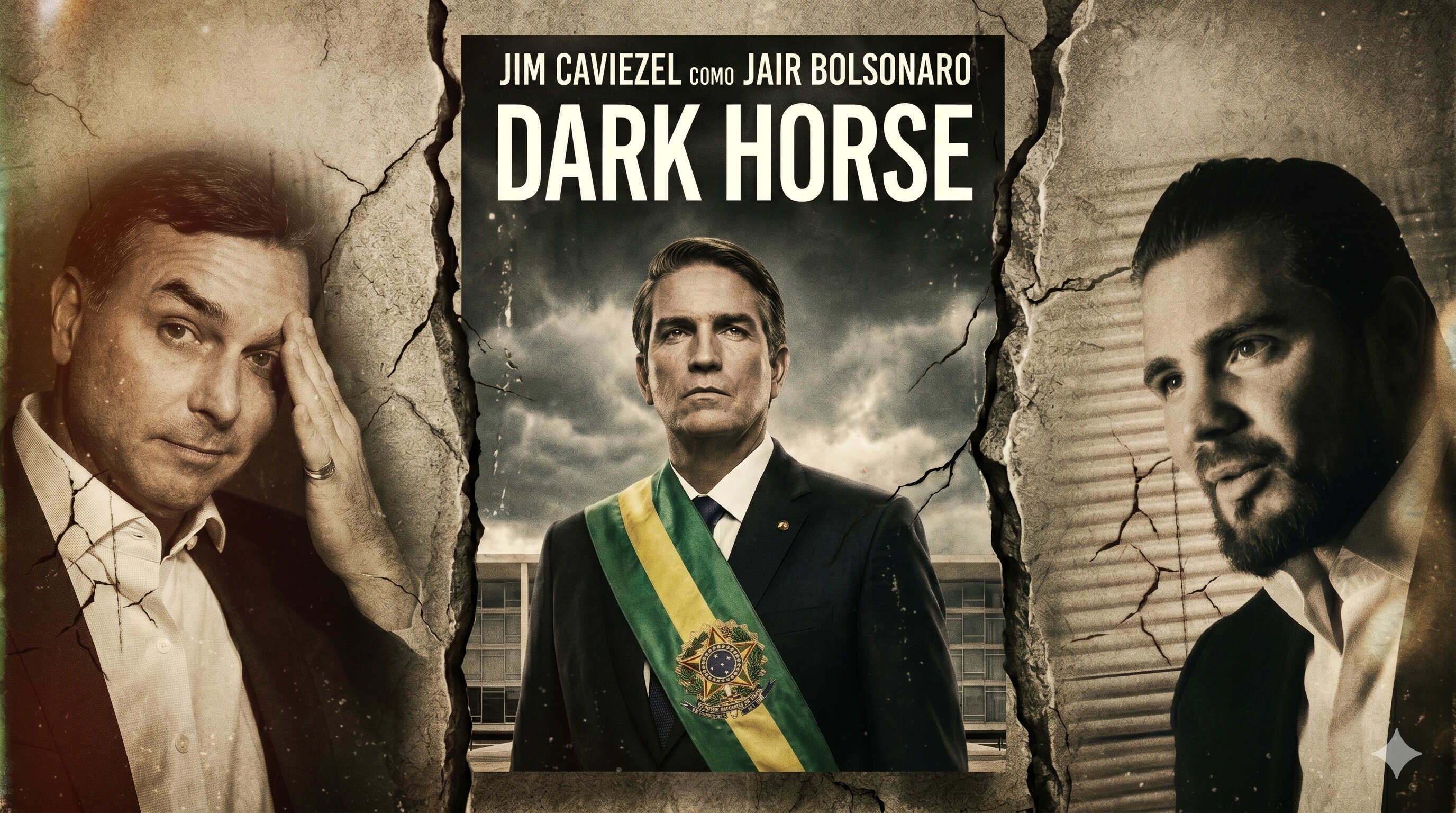
In May, now-presidential candidate Flávio Bolsonaro, the eldest son of former Brazilian far-right President Jair Bolsonaro, shared on his social media a “leaked” trailer for an upcoming biopic about his father. The “most anticipated movie of the year,” Flávio said then, would depict the story of a “true hero.” In the trailer, which had a “disclosure prohibited” watermark, a wig-wearing Jim Caviezel—the American Hollywood actor perhaps most famous for his role as Jesus in Mel Gibson’s 2004 The Passion of the Christ—plays Bolsonaro, who is serving a 27-year prison sentence under house arrest for a failed coup attempt after his 2022 electoral defeat.
Director Cyrus Nowrasteh described Dark Horse as a “tense political thriller about power, media, and faith under fire.” The movie’s trailer, which centers on Bolsonaro’s first presidential run and rise to power in 2018, frames the ex-president as “the voice of the people” and a leader who “fought the system” that tried to silence him. It includes a dramatic reenactment of his stabbing during the campaign. “IF YOU CARE ABOUT OUR ELECTIONS,” Caviezel, who is also known for the more recent Sound of Freedom, posted on Instagram earlier this year, “watch my newest film coming out September 11, 2026!”
The production company behind the movie advertised it on X. “A trailer that circulated online was enough to put The Dark Horse at the center of discussions for months,” says the post in Portuguese. “Now, anticipation continues to grow for one of the most awaited international productions inspired by events that marked Brazil.”
That September 11 date went by and the movie, which was shot in English, has yet to be released in Brazil; it won’t come out before the first round in a nail-biting presidential race set for Sunday, October 4. These federal elections, which include congressional and gubernatorial races alongside the presidential contest, have been dogged by accusations of meddling by the Trump administration, prompting incumbent President Luiz Inácio Lula da Silva to send a clear message to the US leader: “Brazil does not fit in anyone’s backyard.” While Dark Horse has not featured as a centerpiece in that conversation, it has certainly had its own share of controversy even before hitting the big screen.
The Brazil-US joint production has become the subject of an ongoing investigation that has sent shockwaves through the presidential campaign of one of the main candidates in a high-stakes, knife-edge election. Brazilian authorities are actively looking into the financing of the movie by a now-disgraced businessman accused of leading one of the biggest bank frauds in the country’s history. That financial scandal involves banker Daniel Vorcaro, former owner of the liquidated Banco Master, who is jailed for alleged fraud in a complex billion-dollar scheme involving worthless credit portfolios. The imbroglio has rocked the 214-million-people nation and thrown the Brazilian Supreme Court into an unprecedented institutional crisis, ensnaring justices, including Alexandre de Moraes—a polarizing figure credited by some with having stopped Bolsonaro’s coup plot and vilified by others for judicial overreach—and high-profile politicians and public officials with alleged ties to Vorcaro.
Among them is Brazilian senator Flávio Bolsonaro, who is cited in the investigation by Brazil’s federal police into the financing of the movie for “possible participation” in alleged crimes involving “money laundering, illicit capital flight, corruption, and other related offenses.” Last May, the Intercept Brasil exposed audio recordings and messages exchanged between Flávio and Vorcaro in which the senator asks the banker for money to fund Dark Horse. Documents from the federal police indicate Flávio was a “direct interlocutor” in negotiating with Vorcaro about the financing of the movie production.
The bombshell reporting revealed that Flávio, the primary opponent facing off against President Luiz Inácio Lula da Silva, who’s vying for re-election, negotiated a $24-million-dollar investment from Vorcaro. At the time, documents obtained by the Intercept Brasil showed that Vorcaro had made payments for the movie adding up to at least $10.6 million, between February and May 2025; the total has since climbed to $12.3 million, according to the federal police.
In a voice message to Vorcaro from September 2025, Flávio pressed the banker on pending payments, stressing the importance of getting the movie across the finish line. “Imagine us defaulting on Jim Caviezel, on Cyrus [Nowrasteh], these guys, man, hugely renowned in American and global cinema. Man, that would be really bad,” Flávio said in the audio, a transcription of which is cited in the federal police’s inquiry. He added: “Now that we’re in the final stretch, we can’t slip up, we can’t fail to honor the commitments here, because otherwise we lose everything.”
The Bolsonaro camp had high hopes for Dark Horse, originally projected for release three weeks before election day. “We’ll touch the hearts of a lot of people,” congressman Mário Frias, who was involved in the development of the project and is also named in the investigation, told Vorcaro, “and it will be very important for our country.” Ahead of the election, Flávio Bolsonaro, the presidential hopeful, has found himself having to provide explanations. He has dismissed the payments from Vorcaro as “private sponsorship” for a private project, underscoring that no public funds were used in the movie, and denied any wrongdoing.
A $2,000 rental wig for Jim Caviezel
Unsealed court documents state that payment transfers for Dark Horse were made via an intermediary company and processed through the Texas-based Havengate Development Fund managed by a Brazilian lawyer close to Flávio’s brother, Eduardo Bolsonaro, who is self-exiled in the United States since last year following a lawmaker’s request for him to be investigated for allegedly lobbying against Brazil’s national interests. This June, Eduardo, who was stripped of his congressional seat for being absent, was convicted of “coercion” for attempting to secure interference from the Trump administration on Brazil’s internal affairs; he sought to persuade them to impose tariffs on Brazil and sanctions on Brazilian justices to help his father’s case.
Investigators looking into the origins of the money and its destination have raised the “hypothesis” that Eduardo, who lives in Texas, “directed the management of resources on foreign soil.” They also are investigating whether funds from Havengate may have been used to cover Eduardo’s living expenses, according to multiple reports by Brazilian media outlets. Flávio has maintained that all the resources allocated to the fund went towards the movie production.
On X, Eduardo has denied receiving money from the Texas fund, saying his immigration status wouldn’t have allowed it. (He has recently obtained a green card.) “During my immigration process,” he said, “I explained to the American authorities the whole origin of my assets and I didn’t have any problems.” He added that “all the investments were made in the US because the production was American, with American actors.”
Agência Pública, Brazil’s largest nonprofit newsroom, recently reported on Eduardo’s lavish lifestyle; he resides in a luxury home in Southlake, owns a $43,800 SUV, and travels frequently—20 times in 18 months—including to attend a gala at Trump’s Mar-a-Lago, watch a World Cup match in Miami, and surf in Abu Dhabi. Eduardo has previously explained his financial circumstances by saying he lives off of “passive income.”
The former lawmaker denied having any management role in Dark Horse, but a production contract signed in 2024 and obtained by the Intercept Brasil mentioned the ex-congressman as an executive producer in the movie. In response to the article, Eduardo said that he had signed a contract when the project was still in the early stages and invested $50,000 to get a Hollywood director attached to the movie, but he was later repaid and left the project once other investors were secured. Agência Pública contacted Eduardo’s press team but didn’t hear back before publication.
Go UP Entertainment, the US-based production company behind Dark Horse, is led by Karina Ferreira da Gama and Michael Brian Davis. (Ferreira da Gama and an NGO she directs are the target of a separate inquiry into whether public money was used to finance the movie.) According to an audit commissioned by Go UP, production costs in Brazil were $3.73 million. Costs in the United States amounted to $9.66 million—or more than 70 percent of the movie’s roughly $13-million reported spending. The expenses in the United States, according to the audit, included soft production, pre-production, project development, filming, and post-production. On LinkedIn, a production manager who worked on the movie described it as “the largest-budget feature filmed entirely in Brazil.”
The movie’s reported expenses have raised eyebrows among industry insiders, who have compared the numbers to those of an Oscar-worthy production. The company spent $2,000 on a rental wig for Caviezel and about $135,000 in hotel accommodation for the star and his agent and security, based on bank statements and invoices provided to the federal police. ”It’s not a film that will be nominated for an Oscar,” Wilson Feitosa, director of the company responsible for the distribution of Dark Horse, told O Globo newspaper. “It won’t be in contention for a nomination, but it has that Hollywood seal of quality.”
The federal police noted that, even accounting for “complex variables” in estimating the costs of film productions, there was an “apparent mismatch between the projected cost of the production of Dark Horse and the parameters usually practiced in the Brazilian audiovisual market,” saying it warranted further investigation into the “effective allocation of resources” and the purpose of the operation.
“A nightmare for the Left”
Registered in Florida since 2021, Go UP Entertainment listed, until recently, its place of business as Davis’ home address in Raleigh, North Carolina. In June 2026, the address was changed to a commercial location in the same city. The company’s website only mentions an address in Westlake Village, California. A google search for that address leads to another production company, Damascus Road Productions, focused on “family and faith content.” (Ryan O’Quinn, the president of Damascus Road Productions, has promoted Dark Horse on his social media and is listed on the movie’s IMDb page as a producer. He didn’t respond to an email with questions or return a voicemail message.)
“Go UP Entertainment hereby clarifies that it conducts its business activities and the production of the film Dark Horse in a documented and transparent manner and in compliance with its contractual obligations,” the company said in a statement to the Brazilian magazine Piauí. In an email, Davis declined an interview for this article, saying “we will not provide comments on confidential budgets, private agreements and contracts, or unrelated business matters.”
Go UP’s website, which appears to have been revamped this year, states that the company “was born from the union of two creative forces: Go 7 and UP Tone.” Go 7 seems to be a reference to a different company operated by Davis’ co-partner Ferreira da Gama in Brazil. Go 7, which has reportedly never released a movie or TV production in the country, has its registration status with Ancine—the Brazilian regulatory film agency—listed as “irregular.” (Go UP Entertainment’s status is “regular” and Ancine granted Dark Horse a foreign work registration.)
Uptone Pictures is a self-described “independent film production company” in North Carolina that names the Dark Horse producer, Davis, as founder and executive producer. The movie releases featured on Go UP’s page appear to be examples of Uptone’s previous work. Among them are the 2014 A Long Way Off, a modern-day retelling of the prodigal son parable; Paul’s Promise from 2022, a Christian drama about a “firefighter-turned-pastor” produced and starred by O’Quinn; and the Brazilian-American Destiny Road, based on a book by a televangelist. Uptone Pictures lists Dark Horse as one of its credited productions. On Facebook, the company calls itself “your fixer in Brazil.”
Davis has Brazilian citizenship and lived in Brazil in the 1980s, where he learned Portuguese and became a São Paulo soccer team fan, before moving to the United States, according to the BBC News Brasil. Besides Go UP Entertainment and Uptone Pictures, he’s linked to several other entertainment businesses in North Carolina, some of which have been dissolved over the years.
Davis has reportedly said that, on the advice of lawyers, he won’t hand over Go UP’s company documents without a judicial order in the United States. The producer wrote in an email to his business partner included in the investigation that “requests from Brazilian authorities involving documents or data under American jurisdiction must be formalized exclusively through the competent diplomatic and international legal cooperation channels.”
Mother Jones emailed Davis a number of questions about his partnership with Ferreira da Gama, the founding of Go UP Entertainment in 2021, and the company’s office addresses. We also asked him for details about the production and budget of Dark Horse, the company’s audit and expenses in the United States, as well as his reason to refuse a federal police’s request for evidence. Finally, the email included questions about Davis’ business history.
In a note, Davis replied that “given Mother Jones’ far-left editorial orientation and the framing of several of your questions, we do not have confidence that our participation would result in a fair and balanced account of Dark Horse.” He wrote that the “inquiry takes a broad, scattershot approach combining questions about the film with historical business affiliations, registered addresses, and other companies.” Davis also said, “several questions” contained “assumptions, speculations, or characterizations that we do not accept,” but didn’t explain what those were.
Meanwhile, select audiences in the United States have already had a sneak peek of Dark Horse. Back in June, Eduardo attended the first public screening of the movie at the Fraud Fighter Summit in Las Vegas. Speaking at a panel, Eduardo suggested the biopic could have a similar enduring impact to Terminator 2. “This movie,” he said, “is going to be a nightmare for the Left.”





 PayPal