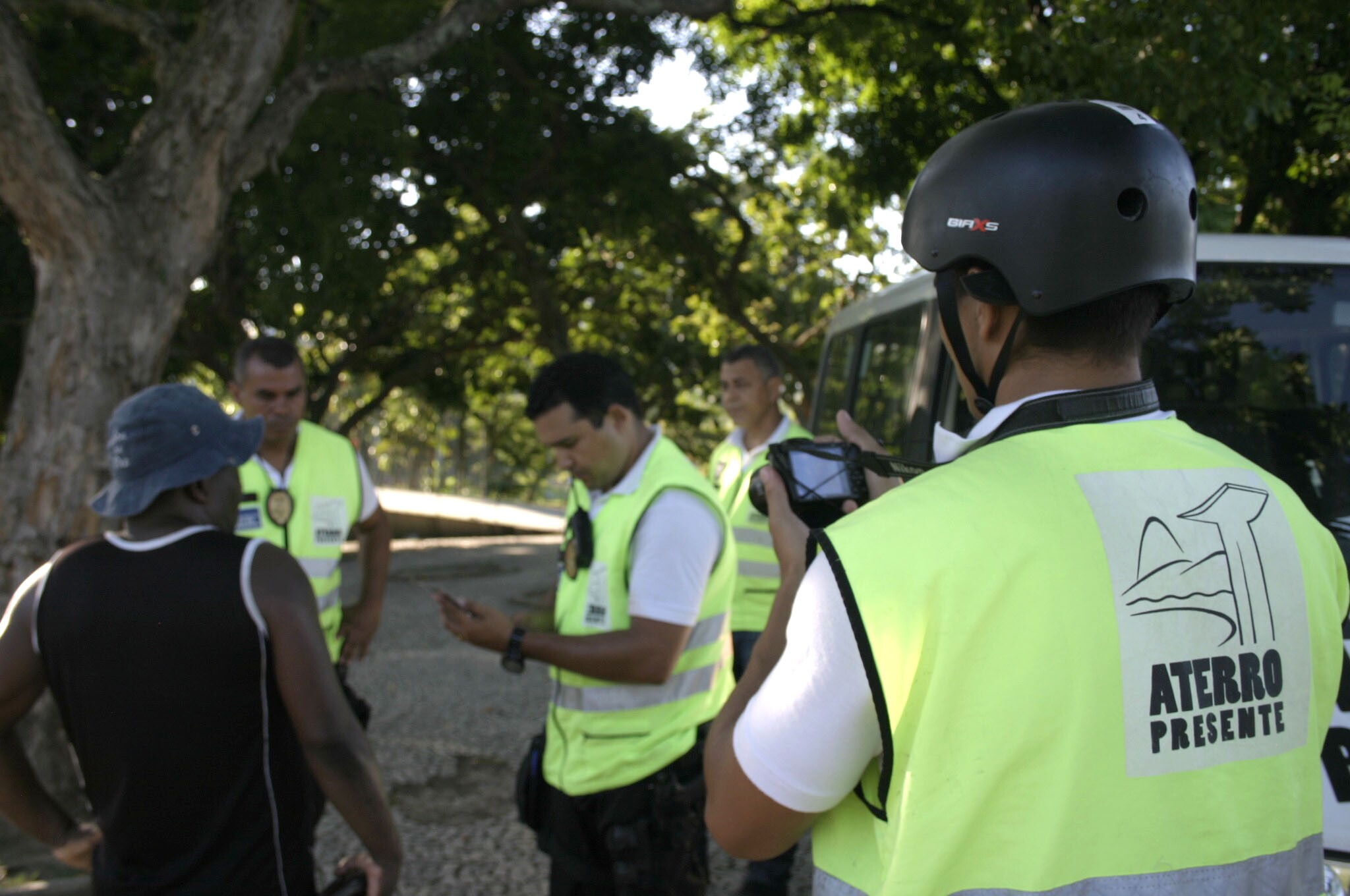
A team of privately funded security officers are patrolling the streets in tourist areas and hauling homeless people off to police stations – and sometimes to shelters 80km away from this Olympic city.
Since December 1 last year, the operation called Seguranca Presente (Safety Present) has targeted three locations in Rio.
The Seguranca Presente officers are currently serving military police officers working on their days off and ex-army officers, wearing identifiable high-visibility vests, colour-coded by area.

Agents have detained 869 people – 584 for possession of drugs and 40 for theft – and also removed 209 homeless people in the past two months.
The operation is paid for by Fecomercio, a federation of 59 businesses in Rio, to the tune of US$12.7m. The move is controversial as it is the first time a security detail in Brazil has been paid for by the private sector.
The 400 agents who patrol the promenade at Flamengo beach – known as Aterro Flamengo, the area surrounding the Rodrigo de Freitas lake that will host Olympic rowing events – and Meier, a shopping district, have been accused of unfairly targeting young black youths and the homeless.
But others disagree.
“The idea is innovative and the statistics as well as the testimonies we have been getting from people show that it has been well-received,” said Fecomercio’s labour relations manager Marcelo Novaes.
The Rio de Janeiro government said it regards the project, the first of its kind in the city, as “fantastic” and “absolutely positive”.
Agencia Publica journalists accompanied the security officers one afternoon. “We approach everyone with a suspicious attitude. For example, if the person runs away when we arrive, or if they try to hide something,” said Lieutenant Gabriel Cavalcante.
A couple chatting on a bench were approached “because they could have been smoking marijuana”, explained Sub-Lieutenant Jannuzzi, who gave only one name.
A black man, riding a bicycle, was stopped because “he is cycling fast and that is suspicious”, said the sub-lieutenant. In all 30 or so approaches – the vast majority involving young black teenagers – the suspects were searched and then freed.
At the end of the day, Jannuzzi encountered three young homeless people. He called for back-up and six more security officers soon arrived, who searched the two small backpacks that contained all of the group’s belongings. They had nothing suspicious, according to the officers, but the homeless teens were detained anyway as they didn’t have identity cards with them.
“If they don’t have any ID, we have to verify the names because there could be a warrant for their arrest,” Jannuzzi explained. Another homeless person was also searched.
“Let’s take them all to the precinct,” he announced. “But you took me there last week,” one of them replied. “Do you want to go to a shelter?” the sub-lieutenant responded in a threatening tone.
“Before, there were a lot of homeless people on the Aterro. Now, you rarely find them. That’s a success,” added the officer. After some hours in the 9th precinct, which is responsible for the area, all four were released.
“This new operation is of a lot of concern to us because it is the same logic of sanitation that existed in the city some years ago,” said Carla Beatriz Nunes Maia of Rio’s Defense Center for Human Rights. She explained that a similar police operation called Lapa Presente, paid for this time with public money, exists in Rio’s main nightlife neighbourhood Lapa and involves municipal guards.
“We have already received many complaints from homeless people about the actions of Lapa Presente agents, who always want to take them to the Paciencia shelter, chosen by the police because it is 80km from the city centre.
“These operations are of the same logic: clean the city – take homeless people as far away as possible to make it difficult for them to get back,” Maia explained.
For federal defender Renan Vinicius Sotto Maior de Oliveira, taking a homeless person to a police precinct because they are not carrying identification is “a practice from the dictatorship.
“Not having ID with you is not a crime and the police know this is illegal. They wouldn’t do this with middle-class people, only with the poor,” he said.
Natalia, a black 18-year-old girl who only gave her first name, said her experience with the security guards left “a negative impression”. She was searched on the Flamengo Aterro in December, when she went to watch a football match, soon after commenting to a friend about the presence of the officers from Aterro Presente in front of them.
They searched her bag and those of her two friends. When they found a tablet in one they suspected it had been stolen and would not believe her explanation.
“They asked a million things and said I looked like a known girl who stole from around there, but they didn’t explain how I looked like her. Now I don’t know if I’m going to go with my boyfriend to these football games if I fit this profile for the police,” she said.
“I don’t know if I was searched because I made a comment in front of the police or because I am black.”
Public defender Rodrigo Azambuja of the Co-ordinating Office for the Defense of the Rights of Children and Adolescents was not surprised when he heard Natalia’s story. “The majority are black,” he said.
One of the big problems, Rodrigo said, is the opaqueness of the funding. The Co-ordinating Office went to court on January 27 with a request to see the agreement between the municipal authority, the state government, and Fecomercio, but the state has still not come up with the contract – even though it was asked to produce it by the judge in December.
“As we still don’t have the agreement, it is very difficult to comment on this operation. But what concerns us is that a private entity can choose the places that will have security – not starting from indicators of crime, but from the needs of businesses,” he said.
Secretary of the state government Paulo Melo admitted the locations – all of which have commercial value and are known leisure and tourist spots – were chosen by the companies that make up the business federation Fecomercio.
“You know, as with anywhere in the world, whoever pays gets to decide,” Melo said.





 PayPal