When President Donald Trump took office on January 20th, 2025, he announced a new trade policy for the U.S. “I am establishing a robust and reinvigorated trade policy that promotes investment and productivity, enhances our Nation’s industrial and technological advantages”, he said. This speech served as an opening gesture for lobbying actors that work to reduce export taxes and tariffs, especially those affecting Big Tech companies.
A month later, the Computer and Communications Industry Association (CCIA) – an organization that represents tech giants such as Amazon, Apple, Google and Meta – issued a list of priorities for the United States Trade Representative (USTR) on what they call “unfair Foreign Digital Trade Practices”. Each year the group sends comments for the National Trade Estimates Report (NTE). In October 2024, CCIA identified 395 “non tariff barriers” in 54 countries.
Taking advantage of the new government’s disposition, the organization reinforced its comments and demanded a “firm response” against measures from 23 of those countries, requesting the use of “all diplomatic and legal tools available” including “bilateral trade agreements or investigations under Section 301 of the 1974 Trade Act.”
The government fulfilled the request and by the end of 2025 included digital trade clauses on deals or frameworks with at least 10 countries, according to an Agência Pública investigation, as part of the investigation Big Tech’s Invisible Hand, a coalition of 17 media outlets in 13 countries co-led with the Latin American Center for Investigative Journalism (CLIP) that investigated tech lobby around the world.
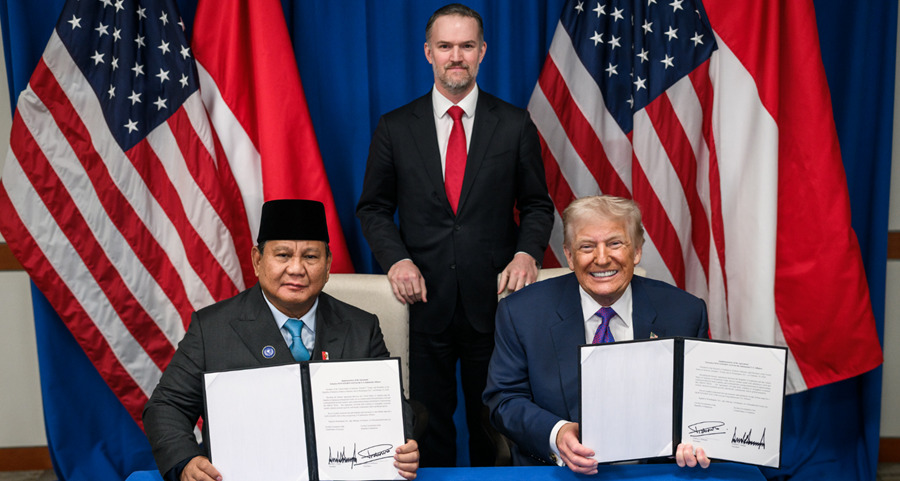
Many of these agreements were signed as a result of the tariffs imposed by the Trump administration, which ultimately served as a pressure tool to prevent regulation of Big Tech firms in these countries. Indonesia signed the latest such deal on February 19.
“The agreements address all the pain points of tech companies through fast bilateral deals, not multilateral negotiations. They impose one-sided obligations. Tech companies presented their priorities, and the US government acted on them. And this never happened before”, says Burcu Kilic, a senior fellow at CIGI (Center for International Governance Innovation), a Canadian based think-tank.
Despite occurring within the context of trade negotiations, the clauses are not limited to reducing taxes and tariffs on products and impact laws and projects that regulate the activity of Big Tech companies in the countries involved.
“In essence, regulating platforms doesn’t necessarily address trade issues, but there is an attempt to frame the economic impact of this as a non-tariff barrier, because regulatory projects foresee fines, for example,” explains Jamila Venturini, executive director of the Latin American organization Digital Rights.
Responding to this report, CCIA denied that there is a direct link between the agreements signed with the U.S. government and delays in Big Tech regulation. “The relationship between tariff negotiations and the timing of digital services regulation varies significantly across jurisdictions, and it is not always possible to draw a direct or consistent link”, said the Vice President for Digital Trade, Jonathan McHale.
The organization also said it prioritizes “good-faith engagement and targeted approaches to address trade barriers rather than raising tariffs for their own sake” when talking to governments and regulatory agencies.
The USTR did not respond to our questions. The space remains open for comments.
Agreements in South Asia
The first country to signal a framework committing to limit digital regulations was Indonesia on July 22, 2025. To lower the tariffs imposed by the U.S. from 32% to 19%, the country pledged to, among other things, “address barriers affecting digital trade, services, and investment” and “provide certainty regarding the ability to transfer personal data out of its territory to the United States.”
In effect, the commitment goes against the country’s data protection law, which requires explicit user consent for the transfer of data to foreign territories. This was one of the priority points that the CCIA sent to the USTR earlier in the year. “Annoyed by this requirement of the Data Protection Law, American companies operating in Indonesia tried to influence the USTR in the tariff negotiation process between the American and Indonesian governments, including the law as a non-tariff barrier,” said Wahyudi Djafar, director of the Indonesian Institute for Policy Research and Advocacy.
In response, digital and civil society activists organized protests across the country. “The population reacted because they didn’t like having their data treated as a bargaining chip in tariff negotiations,” explained Djafar.
According to Chairman of the Indonesia Cyber Security Forum, Ardi Sutedja, designating the United States as a trusted jurisdiction as stipulated in the agreement may create the perception that U.S. data protection is already adequate.But he says that, in reality, international best practices still require transparency and risk assessments, including against the possibility of illegal access by foreign governments.
The Indonesian government, Ardi said, cannot ignore the risk of loopholes that allow foreign businesses to bypass data protection requirements applicable in Indonesia. Without proper regulation, data transfers could instead facilitate excessive data collection, from profiling to misuse for commercial or political purposes.
Other discussions about social media regulation also cooled down in the country. The implementation of the national data protection authority, which was supposed to be appointed by Indonesia’s president by 2024, for example, has not yet happened. “Companies know that if Indonesia fully implements the Data Protection Law in the country, they will not be able to transfer data from Indonesia to the US, because they don’t have an equivalent data protection law,” says Djafar.
Additionally, the agreement has also raised concerns within the Indonesian media industry about its potential impact on the country’s publishers rights initiative. Press organizations warn that these provisions could weaken mandated obligations for major platforms to financially support news production through licensing and revenue-sharing schemes.
“Its nature shifts from mandatory to voluntary,” said Publisher Rights Committee member Sasmito Madrim at the Indonesian Press Council building on February 24, 2026 to Tempo, a partner of Big Tech’s Invisible Hand.
A final agreement between Indonesia and the US was signed on February 19, following commitments signaled last year. According to an analysis by the watchdog group Public Citizen, the new deal “eliminates tax, privacy, and accountability regulations on Big Tech.”
The same path is being followed by other governments in Southeast Asia. On October 26, 2025, five other countries in the region made progress in negotiations on tariffs related to digital trade. For instance, Vietnam included a clause to “finalize commitments on digital trade in services and investments” in the framework for a trade deal with the US.
The agreements signed by Thailand, South Korea, Cambodia, and Malaysia with the US were even more incisive. All four countries pledged not to implement “discriminatory” measures against US digital services and products.
According to experts consulted by Agencia Pública, the expression is vague and could target any legislation that imposes limits on digital platforms, since the vast majority of them are concentrated in the US.
“When a country commits to a non-discrimination clause, they actually end up not being able to impose any kind of regulation on digital services, because if you want to impose legislation on search engines, for example, the law will practically only apply to American companies, which could be seen as discriminatory,” explains Burcu Kilic.
Anticipating this possible interpretation, the Malaysian government added a footnote to the “non-discrimination” clause stating that “for greater legal certainty, Malaysia has the right to regulate in the public interest.” However, this observation does not appear in the version of the deal published on the White House website.
Digital rights activists in the country fear that the agreement will continue a policy that gives carte blanche to American companies that handle Malaysian data. In January 2025, the government signed an executive order that excluded companies such as Amazon, Microsoft, and Google from the requirements imposed by the Cybersecurity Law approved in 2024 in the country. “With the order, these companies were exempted from the obligation to report cybersecurity incidents and data breaches,” explained Khairil Yusof, coordinator of the Sinar Project, a Malaysian digital transparency organization. He believes the “non-discrimination” clause could be an attempt to “extend this exception to all U.S. companies,” such as Mark Zuckerberg’s Meta and Elon Musk’s X.
The agreement also guaranteed a cross-border transfer of electronic data between the US and Malaysia “for the conduct of business” and established a partnership between the two countries to “address cybersecurity challenges and matters of mutual interest.” Identical clauses were included in the agreement signed with Cambodia.
“These agreements make countries even more dependent on U.S. digital services and, consequently, lose the ability to regulate them,” says Kilic.
Reducing the regulatory space in Latin America
The same strategy was repeated in Latin America. Argentina, El Salvador, Ecuador, and Guatemala signed frameworks for trade deals with the US that include clauses on digital services.
In the Argentinian case, in addition to the repeated “non-discrimination” clause, the country also agreed to “recognize the U.S. as an appropriate jurisdiction under Argentine law for the cross-border transfer of data, including personal data.”
For Jamila Venturini, the agreement represents an attempt to “circumvent local data protection law” which, like Indonesia’s, requires user consent for the transfer of data to third parties. “They are establishing, via bilateral agreement, an exceptional authorization for data sharing with a country that does not have an equivalent level of protection,” she says.
The four countries pledged to support a permanent moratorium at the (World Trade Organization (WTO) on tariffs on electronic transmissions that is being pushed by the US. This commitment was made in the context of the expiration of the organization’s existing rule that prevented this type of taxation until this year.
“What the United States did through these bilateral agreements, which also relates to this administration’s stance of not respecting multilateral forums, was to shield itself against any change in this direction,” explains Venturini.
Pressure has an effect beyond agreements
The agreements between Argentina, Ecuador, and El Salvador could be explained by the close relationship between the right-wing presidents of these countries and Trump, but they create a pressure for other non-allied countries to accept similar terms. “When you have a group of four or five countries that have already signed these conditions, the US would be able to validate their strategy,” Venturini assesses.
This is the case in Brazil. Although the country has not signed any agreement or commitment with the United States and has moved forward with some projects to regulate platforms – such as the approval of the Digital ECA last year, which establishes accountability, parental control, and the mandatory implementation of measures to prevent children’s exposure to adult content, bets, and pornography – the imposition of tariffs by the US has had an impact on discussions of digital rights at the domestic level.
“The weight of the pressure fell on the artificial intelligence project,” assesses Alexandre Gonzales, a member of the Rights on the Network Coalition. Bill 2338/23, which aims to regulate the use of AI in the country, was approved in the Brazilian Senate at the end of 2024 and was scheduled to be passed by the Chamber of Deputies in 2025, but ended up losing momentum. The proposal had been listed as one of the priority non-tariff barriers presented by the CCIA to the American government in February 2025, along with projects for the regulation of streaming services (Bill 2331/2022) and the regulation of digital markets (Bill 2768/2022).
According to Gonzales, the three proposals underwent changes or were delayed following the imposition of tariffs by the US. “My interpretation is that they are presenting a weak version of regulatory or tariff proposals, supposedly to appease the White House and the lobby of these large companies,” he says.
“It’s a constant underlying pressure, like a measure that generates widespread legislative self-censorship. So any attempt to regulate digital services can end up being silenced by a fear of triggering a trade penalty from the United States,” adds Venturini.
Additionally, at the request of Big Tech lobbyists – as revealed by Agência Pública – the US embassy sent Matthew Lowe, Economic Affairs advisor, to the Federal Senate to lobby against the vote on the bill that would regulate streaming services and social networks that monetize videos. The bill was not voted on.
This is the so-called “chilling effect,” highlighted in research by Digital Policy Alert, (DPA). “Governments are adapting their domestic digital policies even without deal commitments” the study reveals. The examples include the elimination or reduction of taxes on digital services in Canada, Pakistan, and India. “It applies pressure not only to existing policy, but also to proposals and enforcement action.” says the study.
At the end of last year, the CCIA praised the US government’s “progress” in negotiations on digital tariffs. “Commitments made on digital trade between the U.S. and Malaysia, Indonesia, and the EU this year on topics including network usage fees, digital taxes, and local content requirements are encouraging, and we welcome continued focus on outstanding barriers to U.S. digital services exports,” said a statement published at the end of October.
For this ongoing work, the organization sent a new list of what it considers “non-tariff barriers” to digital commerce to the USTR, citing 516 measures from 61 countries – 30% more than the previous year – especially in Southeast Asia, Oceania, and Latin America. The document cites as “asymmetric platform regulation initiatives” the discussions in Australia regarding the implementation of a digital markets law following the European model, as well as Bill 4675/25 in Brazil. The CCIA also refers to measures that require greater data security for children and adolescents online as “government content restriction,” such as the Digital Child Protection Act (ECA Digital) in Brazil, the ban on social media access for children under 16 in Australia, and similar initiatives under discussion in Canada, Colombia, and Indonesia.
In fact, the pressure is far from over. In February, the White House advanced negotiations with India and Bangladesh to reduce tariffs imposed on products from these countries. The framework for the agreements echo clauses that could undermine data protection and the regulation of Big Tech—such as the elimination of so-called “discriminatory barriers” on digital services and the “free transfer of data” between the countries.
Even with the US Supreme Court striking down Trump’s international tariffs in February, experts say the US will continue to push for limits to digital services regulations in other countries. “Governments with digital policies that cross with US interests should expect more pressure, learn from each other on the international level, and strategize on domestic implementation,” argues the report by Digital Policy Alert, (DPA).



 PayPal