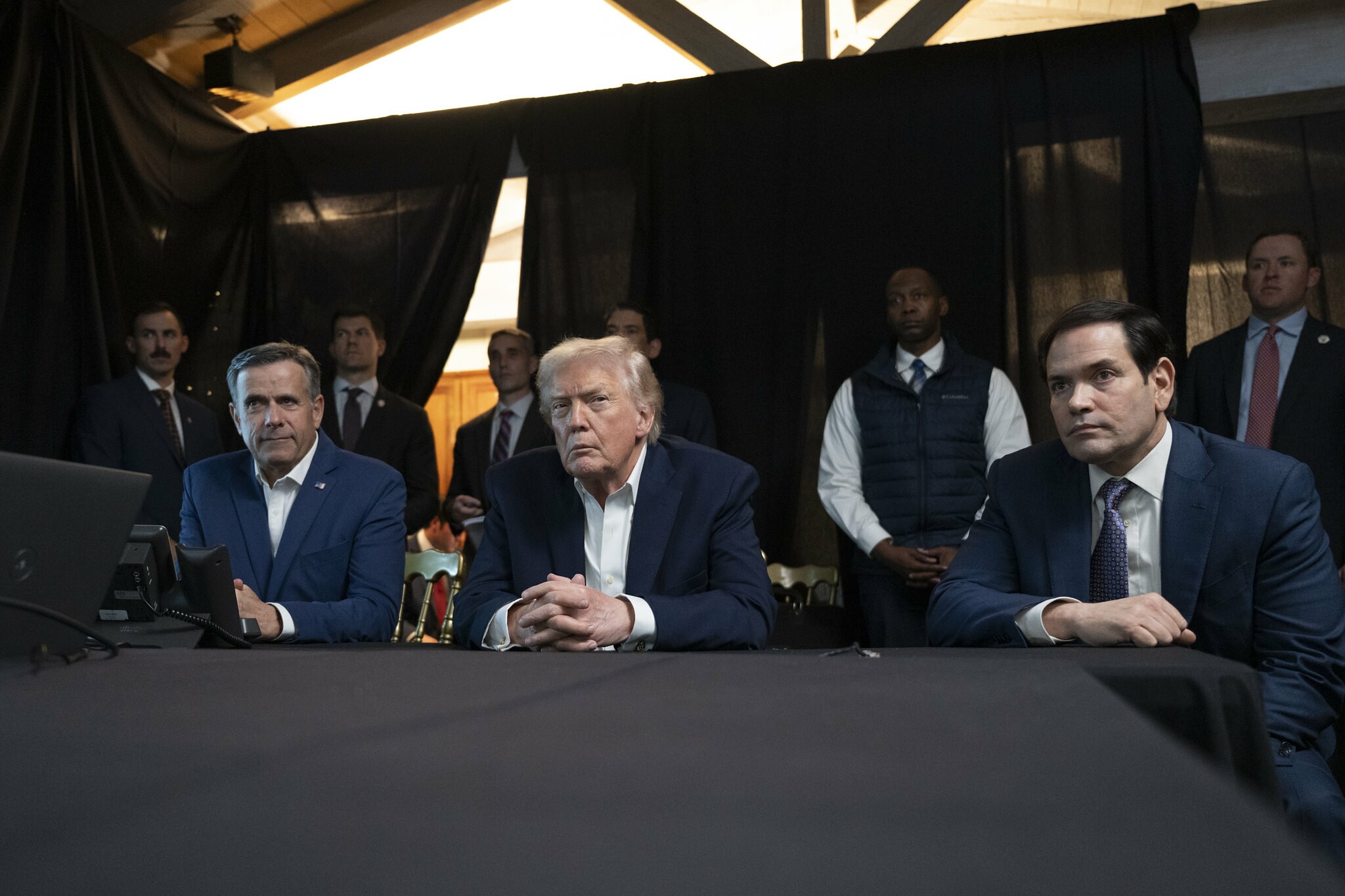
Oil or power? These two elements were laid bare in Donald Trump’s remarks as he sought to justify the illegal attack on Venezuela and the kidnapping of Nicolás Maduro during a nearly hour-long speech delivered on Saturday, January 3, in Florida.
“We’re going to rebuild the oil infrastructure, which will cost billions of dollars. That will be paid for directly by the oil companies. They will be reimbursed for what they’re doing, but all of this will be paid for, and we’re going to make the oil flow the way it should […] We’re going to sell it,” Trump said, making strikingly explicit the interest of the United States — and of oil companies — in entering Venezuela.
In addition to uttering the word “oil” nearly 20 times, Trump also signaled what it means for the United States to remove Maduro and decide how the country should be governed: “Venezuela has a lot of bad people inside, a lot of bad people who should not be leading. We’re not going to take the risk of one of those people replacing Maduro […] We need safe countries around us,” he said.
For the economist and co-director of the Center for Economic and Policy Research (CEPR), Mark Weisbrot, this pairing of words — “oil and power” — explains what motivated the United States’ illegal action in Venezuela, while also illustrating the worldviews of the two men who currently exert the greatest control over U.S. foreign policy: Trump himself and Secretary of State Marco Rubio.
“For Trump, it’s about oil. But for Marco Rubio, the issue is much more about regime change […] And it’s not just about Cuba and Venezuela; they want to reshape the entire region,” he explains in an interview with Agência Pública.
Weisbrot argues that Rubio is one of the leading advocates of a project in which the U.S. increasingly intervenes in Latin American countries, following the logic of the so-called “Donroe” Doctrine, to oust adversaries and retain only governments that are subservient to Washington. Under this plan, priority targets would be Cuba and Colombia (whose president was directly threatened by Trump). Brazil and Mexico are also on the radar — even if it is unlikely that the U.S. would act in the same way in those countries as it did in Venezuela.
“[In recent decades] the U.S. has launched regime-change efforts against almost all social-democratic governments, including Brazil […] They don’t want any country to have the power. This is also true of [the U.S. relationship with] Lula. They didn’t like \that Lula didn’t align himself with their geopolitical project, which is a project to dominate all the governments they can,” he says.
Read the full interview.

In your view, what is the central motivation behind the United States’ attack? Is it oil? International geopolitics? Some other factor?
For Trump, it’s about oil. He’s stated this repeatedly… But for Marco Rubio [United States Secretary of State], the issue is much more about regime change: he sees this change as a step towards his lifelong dream of promoting regime change in Cuba.
This regime change operation in Venezuela has been going on for 25 years; US State Department documents from 2002 acknowledge the United States’ substantial role in the coup of that year [at the time, a failed coup attempt tried to remove President Hugo Chávez from power]. And this has much more to do with power than with oil. And these efforts at regime change have been continuous to today.
With the world’s largest oil reserves, what could actually change for the United States, in terms of access to oil, if regime change were to take hold in Venezuela?
I don’t think there will be much immediate interest from American oil companies in Venezuela, because the situation is too unstable, and the Trump administration itself is very unstable in terms of what it might do next.
Why didn’t the United States try to negotiate the oil issue with Maduro, who from the beginning said he didn’t want a conflict?
Trump and his special presidential envoy Richard Grenell did try to negotiate the oil issue with Maduro; it’s not clear why this did not succeed, but it’s possible that Rubio’s continuous push for regime change and other more violent approaches is part of the answer.
There have been big differences between Rubio and Trump on this point. Trump was interested in oil, and Rubio wanted regime change. And so, according to press reports, for example from the New York Times – while Trump wavered between the choices of trying to negotiate an oil deal with Maduro or trying to overthrow him– Rubio seemed to be, according to accounts from people who spoke with him, trying to convince Trump that the best way to obtain the oil was through regime change.
How central is access to additional oil and gas reserves for Trump’s USA?
The United States is a net exporter of more than 800 million barrels of oil annually, and so does not need to have access to Venezuelan oil. But Trump does not accept that the global climate is, in fact, changing as a result of fossil fuels; so for various reasons he seeks to increase fossil fuel production in the United States.
One possible reason that this access to Venezuelan oil could be important to Trump: Trump is widely seen to have accumulated billions of dollars from being president, an unprecedented phenomenon in the United States.
So, it’s conceivable that Trump might see oil as another major investment that could benefit him and his family.
Beyond oil, how important is it for Trump to assert influence in Latin America as part of his geopolitical agenda? How do the “Donroe” Doctrine and the confrontation with Chinese influence fit into this strategy?
Well, for Rubio this is really important. And it’s not just about Cuba and Venezuela– he and his allies in the Trump administration and Congress want to transform the entire region. Cuba and Venezuela are only part of that transformation. It’s important to remember that, in the 21st century, at a certain point in the first decade, most of the Southern Hemisphere lived under center-left governments, mostly social-democratic. Some were known as socialists, but in practice, they governed as social democrats. Economically, the left-of-center governments were very successful, reducing poverty in the region from 44 to 28 percent from 2002-2013, after 20 years of no progress on this front at all. It’s not that the US government was against reducing poverty; it just did not want to tolerate the national independence that Latin American governments needed to produce these results. And that is even more true today with people like Rubio and Trump at the helm.
In the 21st century, the United States launched regime change efforts against nearly all of Latin America’s social-democratic governments, including Brazil.
Lula has noted that the US government worked to help put him in prison in 2018 so that he couldn’t run for the presidency that year. And they also helped and supported Dilma’s impeachment. And I could spend hours talking about all the democratically elected governments in Latin America that the US tried to get rid of in just the 21st century: including support for coup d’etats that removed presidents in Bolivia, Honduras, and Haiti; and had an enormous negative impact on left–of-center democracies in Argentina, Paraguay, and other countries.
Just a few weeks ago, they even interfered in the Honduran election [at the end of 2025], with Trump very forcefully saying that Honduras would be punished if the electoratedidn’t vote for Trump’s chosen candidate. Of course, the Barack Obama administration also supported the coup in Honduras in 2009.
But Venezuela has been the primary target for regime change in Latin America, and one of the top targets in the world, for most ofthe last 25 years, with some exceptions such as the war in Iraq.
And they have paid a horrific price for that in terms of death and suffering. US sanctions have caused most of the worst peacetime depression in history, in Venezuela, with tens of thousands of lives lost from just the first year of Trump sanctions in 2017-18; and vastly more than that in the years from 2018-22.
It’s about oil, but more about power, because Venezuela, with 300 billion barrels of proven reserves of oil, will always be a country with influence. At one point, in the first decade of the 21st century, they were providing more foreign aid to Latin American countries than the United States. And that’s what the US government doesn’t want.
They don’t want any country to have the power, most importantly, to pursue – especially as a group– a foreign policy that is independent of the United States. And that’s also been true for the US relationship with Lula. They didn’t like that Lula didn’t align himself with their geopolitical project, which is a project to dominate all the governments that they can.
Trump stated in an interview with Fox News that something had to be done about Mexico, citing the activities of drug trafficking groups. How much reality do you see in this threat?
Well, Trump is threatening Mexico, there’s no doubt about that; Rubio would likely see Sheinbaum as a problem because she’s an independent president, and she recognizes, as do the other remaining independent governments of the region, how important national sovereignty is… Again, it’s about power.
So they don’t perceive her as being on their side, but she has been careful to manage her relationship with the Trump administration, and Rubio knows that a regime change operation there would be difficult and potentially very messy. But they have threatened to take military action within Mexico, and you never know when they might find it useful for their purposes to do that.



 PayPal